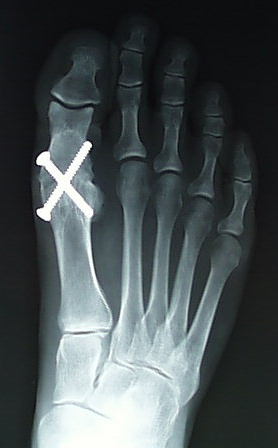
Great toe fusion is typically performed in patients who already have significant arthritis of the 1st MTP joint (hallux rigidus). It can also be performed as a salvage procedure for patients with severe bunion deformities (hallux valgus)
Procedure
Fusion of the great toe is also known as a 1st MTP joint arthrodesis. This procedure involves fusing or “soldering” the great toe joint (first MTP joint) together. The goal of surgery is to make the great joint solidly aligned and immobile. It essentially turns a painful stiff joint into a painless stiff joint. A fusion relieves much of the pain since motion through the arthritic joint is eliminated.
To fuse the great toe joint, any remnant cartilage on the arthritic joint surface is removed and the underlying bone is prepared for fusion. The joint is positioned in a manner which maximizes walking ability and maintains acceptable clinical alignment. This is traditionally done with the toe positioned so that it just gently touches the ground in a weight bearing position. The fused joint can be fixated with multiple screws alone (Figure 1) or with a plate and screws to stabilize the joint. Patients often worry that they will “lose motion” when their big toe joint is fused, but the reality is that for most patients they will have very little, if any, functional motion (motion with the toe in a loaded position) by the time they need to get the joint fused.
Figure 1: Typical Great Toe fusion with screws
Recovery
Depending upon the age and overall health status of the patient, recovery requires a period of 6 to 12 weeks to allow for adequate healing of the bone. During this time, depending on the fixation chosen by your surgeon, it may be possible to bear some weight through the heel, provided a stiff soled shoe or boot (ex. Cam Walker) is used. The exact recovery plan will be determined by the surgeon and by the quality of the patient’s bone. Following a period of early healing (usually 6 weeks), patients are able to increase their activity level and transition to a stiff-soled shoe with a wide-toe box. Post-operative compliance with any weight-bearing and/or physiotherapy protocol is critical to avoid complications, such as failure of fixation with loosening or breakage of hardware, loss of alignment, or non-union (unsuccessful bridging of mature bone across the fusion or fracture site). These complications can result in continued pain and the need for revision surgery.
Malposition of the joint is a possible complication due to the difficulty the surgeon may have in determining the most appropriate position to fuse the joint. Malposition of the great toe fusion is a relatively uncommon complication. However, sometimes even subtle malposition of the great toe can create symptoms because the great toe is subject to a disproportionate amount of force during walking. In the rare cases that this occurs, it can often be rectified by repositioning the toe with further surgery.
Nonunion of the joint
Nonunion is probably more common than malunion (malposition) for 1st MTP joint fusion. Factors that can increase the patients’s risk of nonunion across the fusion site are diabetes mellitus, smoking, noncompliance with post surgical protocol, poor nutrition, medications, vitamin D deficiency, infections, and hormonal irregularity. In the event that a symptomatic patient is unable to successfully bridge this area of fusion with mature bone, a revision procedure may be needed. Revision of 1st MTP joint fusion commonly incorporates increased hardware for added stability and bone graft to improve biological healing at the surgical site.